
Regular Walks
Local, historical walks in Hounslow Borough

BRENTFORD ever changing today, modernisation conflicting somewhat with earlier descriptions as a dirty market town and the place where three major battles took place, from the Romans crossing the Thames 54 BC, Saxon defeat 1016 of Danish King Cnut to Royalist capture and sacking of the town during the Civil Wars 1642.
There are 300 years of the town’s buildings to explore, from its oldest, St Lawrence Church’s 1480s tower, through to a former Magistrates Court sporting Victorian beginnings now converted to commercial space and luxury apartments. Addition of the Grand Union Canal fashioned as the Grand Junction Canal in 1794 adds another dimension leading along the towpath as it does to Boston Manor Park setting for a grand house built 1623 for Lady Mary Reade.
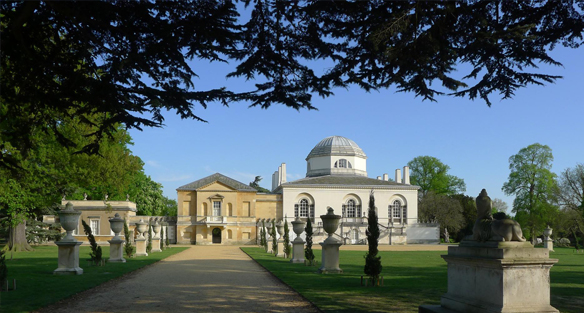
CHISWICK’S Parish Church is aptly dedicated to St. Nicholas patron saint of sailors and fishermen overlooking as it does the River Thames.
Positioned on the main route to the west Chiswick became from the 16thC a popular country retreat for City dwellers with painter William Hogarth and poet W.B. Yeats among its famous residents. It should be no surprise that a large number of handsome early buildings survive, including Chiswick House built 1726-29 its concept that of the 3rd Earl of Burlington.
By contrast the area can claim some notable industrial achievements, the first naval torpedo boats were built here, also inventions such as Cherry Blossom boot polish and linoleum. Chiswick has more than its fair share of ghosts possibly of local inhabitants, one a reputed highwayman.
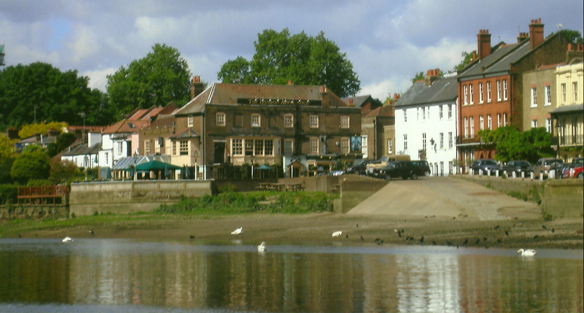
ISLEWORTH, a lesser-known picturesque village set by the Thames that attracted artist J M W Turner to live there in the early 1800s. Formerly a major market gardening centre by 1840 these covered 875 acres and only declined in the 20thC.
Isleworth evolved to become an industrial community with flour, beer, soap and fruit jostling for position for export from its busy wharves. These are overlooked by the 18thC London Apprentice Public House and Parish Church dedicated to All Saints, a marriage of different eras from its 14thC tower to a main body 1960s re-build.
Through Isleworth’s centre runs a man-made watercourse that once powered its flour mill. Now known as the Duke of Northumberland’s River, its name reminds of Isleworth’s most famous landmark, palatial Syon House and Park. In contrast to this are a range of almshouses the oldest built 1664, its benefactor Sir Thomas Ingram a colourful character, alongside a variety of 18th, 19th, and 20thC buildings, with former inhabitants adding to its rich history.
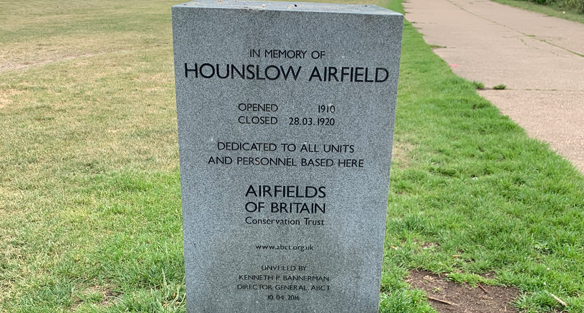
HOUNSLOW HEATH. Originally the heathland was crossed by main routes from London to the West and southwest of Britain, and has sites of Bronze Age and Roman encampments. A survey 1546 suggests an area of some 6.71 square miles, this now somewhat depleted with what remains a wildlife haven. Used by medieval armies during the Barons Wars of the 13thC, King Henry Vlll hunted there and established military industries.
Various armies have used the heath, with Oliver Cromwell stationing an army in 1647 and James II conducting military exercises and mock battles that attracted large crowds to watch the spectacles. Between the 16th and 18th centuries the heath accrued a reputation for harbouring highwaymen resulting in a range of colourful stories. By contrast it became a training base for the Royal Army Flying Corps that evolved into the Royal Air Force, the first aircraft departed 1909 with ten different squadrons based and training there 1914-15.
The Heath became Britain’s first international airport after WW1 with regular flights to Paris, Amsterdam and Brussels while the first flight to Australia took off from there. However, a decision was made the airport was too small with the last flight in 1920.